Carrément
27.09.18 - 18.11.18
CENTRALE.lab
Brussels
Edward Liddle, the virtues of a lateral approach in painting.
The work of Edward Liddle, British painter, artist, who spent several years in Brussels after graduating from the University of Brighton and Goldsmiths College, is informed by a relationship with the painterly gesture which may seem paradoxical to say the least.
His interventions, at first glance, seem to relegate the painterly act to a conceptually and spatially marginal position, whilst emphasising it’s structural and founding demeanour, which is often deliberately incorporated or even embedded/camouflaged within the exhibition space.
Liddle’s pictorial interventions are characterised by a particular porosity of aesthetics, one which not only straddles artistic disciplines, but also, due to their liminal arrangement, the plastic arts proper and furniture or architectural design. In this manner, they willingly assume a sculptural presence and shape.
Due to their immediate relationship with the architectural elements and/or the possibility of furniture which may or may not be present in the space, his interventions surreptitiously prompt a different spatial understanding of the latter, without the viewer realising it at first sight.
The lateral approach, throw away painterly gestures and the specific media, can also be found in the artist’s graphic motifs.
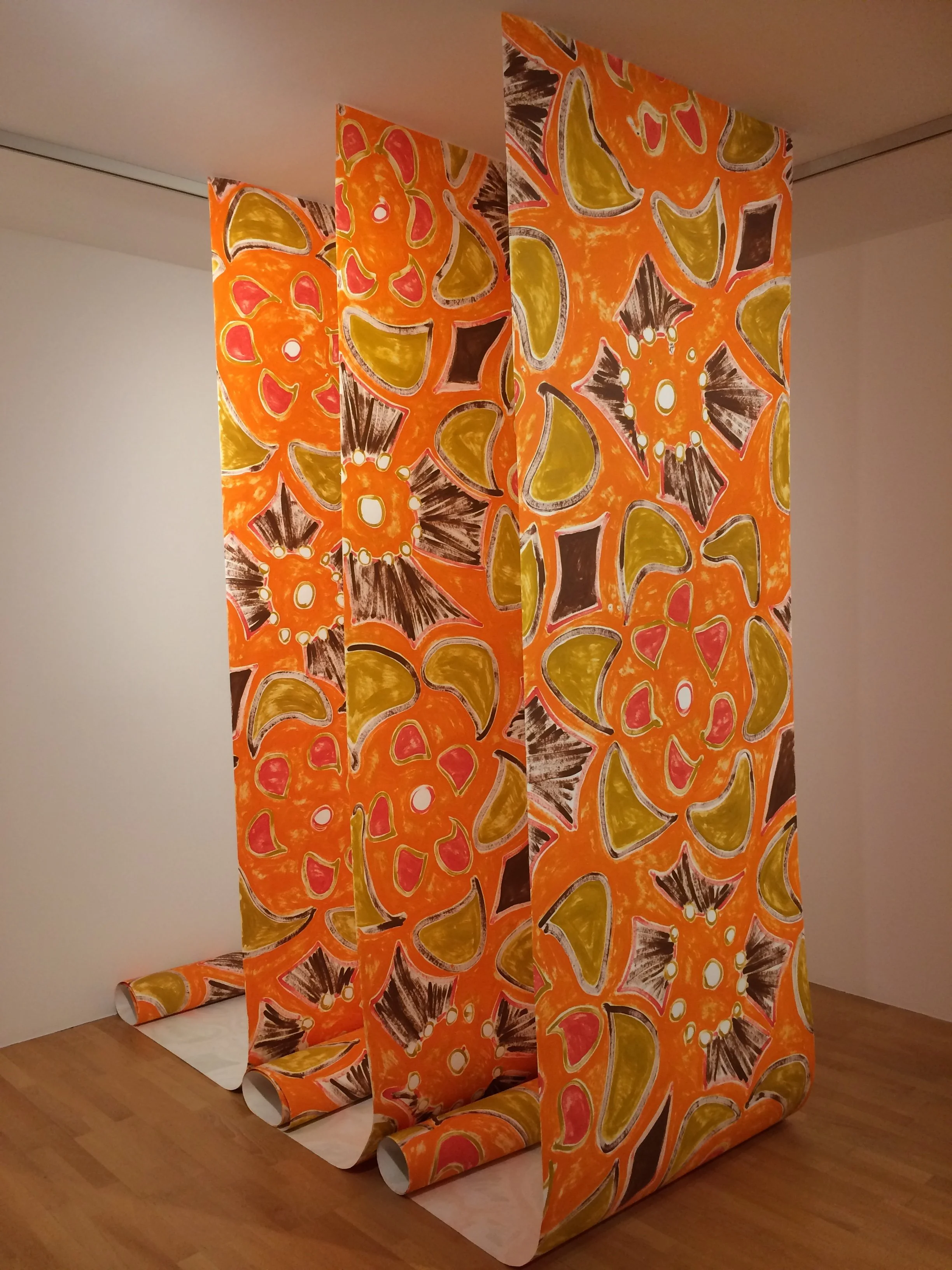
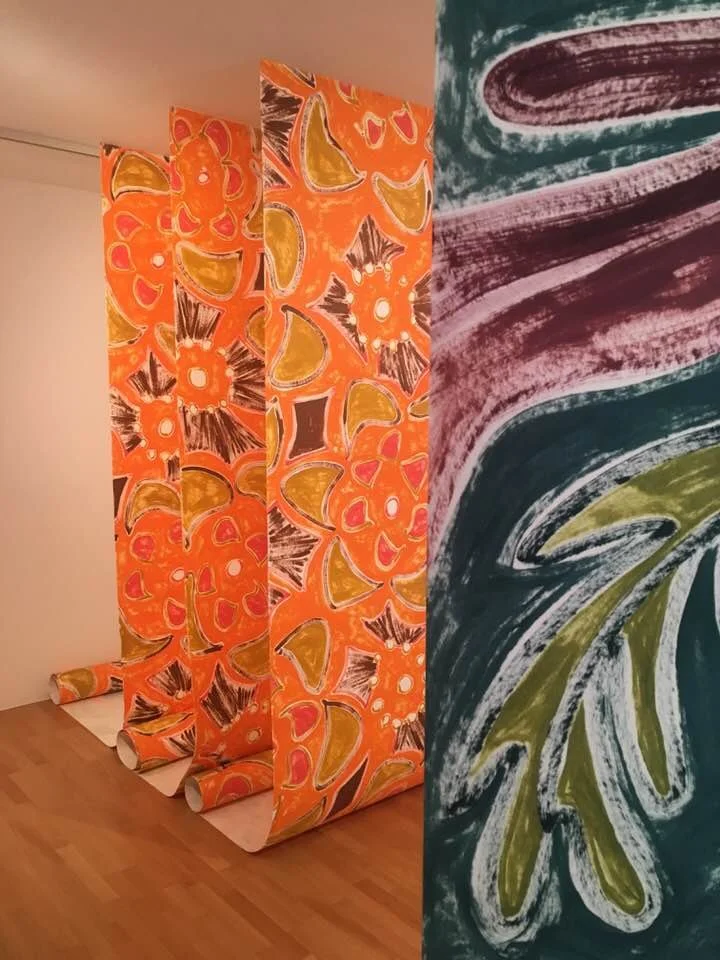
Such as the strips of wallpaper that we encountered as part of his duet exhibition at Hypercorps which comprised of borrowed motifs from image libraries gathered during the wanderings of the artist, without pretension or desire to construct a narration.
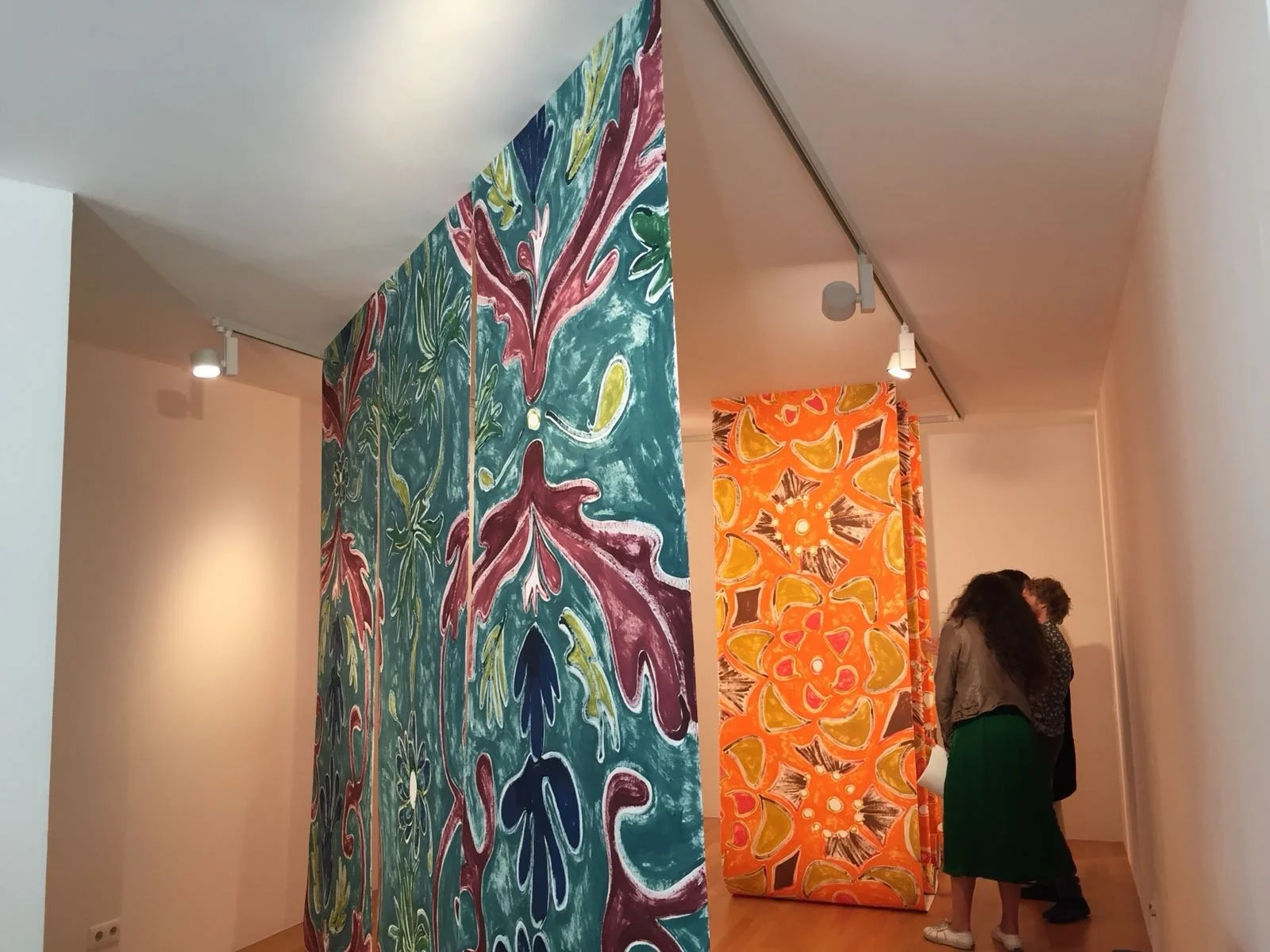
Whilst informing the tonality of the installation, they structured the exhibition space and because of their various uses, created a tension, forming a sort of plastic landscape posing as much sculpturally as chromatically and which subtly dialogued with the decontextualized and quietly obsolete casts made by Lucie Lanzini.
These characteristics can be found in an unquestionably radical manner in the Carrerment! project, developed by the artist for the specific space – and not the easiest to work with – of CENTRALE.lab.
The satellite project room of CENTRALE for contemporary art, located behind the Sainte-Catherine church, is comprised of two overlapping spaces; one at street level, slightly elevated whilst the other, mezzanined in relation, is connected to the first by a staircase which provides views from above of the lower floor. The street front aspect and the relatively cold character of the architecture undoubtedly encouraged Liddle to develop a project to exacerbate the commercial potential of the window front location.
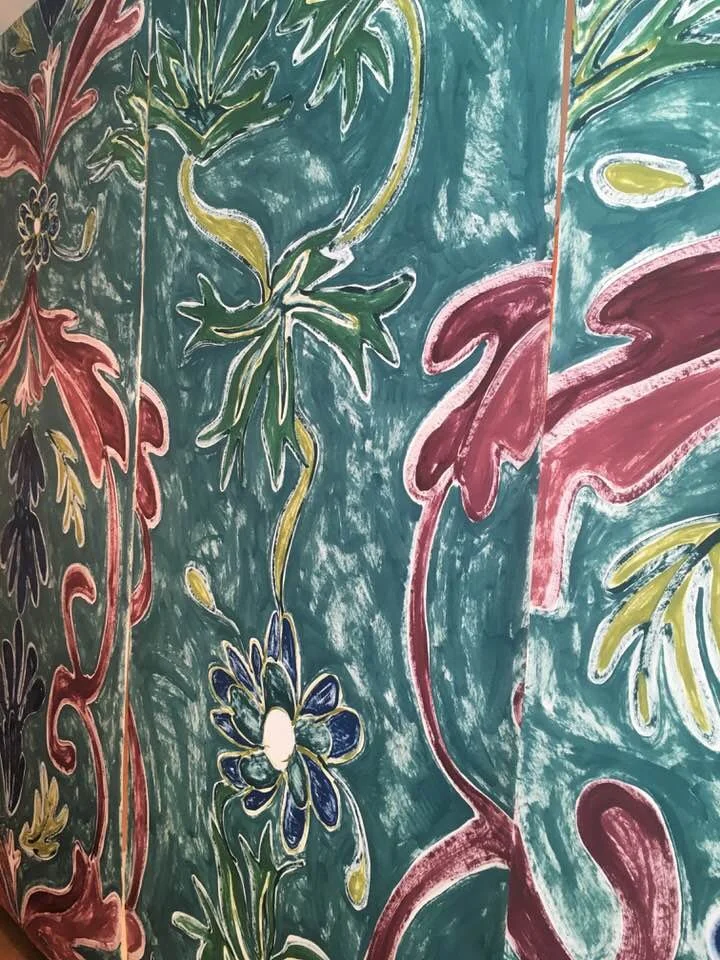
Visitors start the visit with a presentation of several groupings of wallpaper strips painted in the same spirit as those he had previously created for Hypercorps. Consisting of groups of three, each sharing a common motif, they invest and structure the exhibition space with a sculptural presence that is both dynamic – through a play on recessive space – and frontal, by way of playing with the functional ambiguity of a space which could equally function along the lines of a commercial products showroom – which is obviously not the case.
Faithful to the spirit of de-hierarchization which presides over the gestures and pictorial choices of his practice, the wallpaper lengths are grouped in series of 3 featuring pictorial reproductions of the motifs and/or objects found by the artist during his encounters or wanderings in the capital, ranging from a recovered scrap found in a skip outside a building under renovation, to a motif discovered amongst the wallpaper hanging in a friend’s attic. In a way, it’s as if Liddle has recomposed in a filtered, thinly veiled manner, a sort of subjective and mediated portrait of his relationship with Brussels.
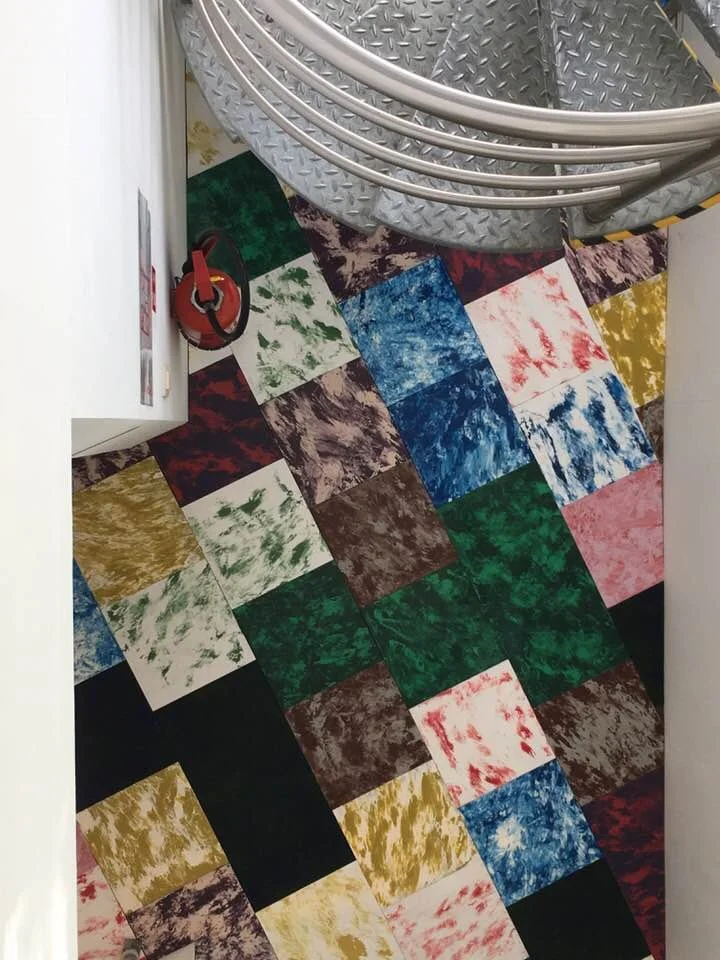
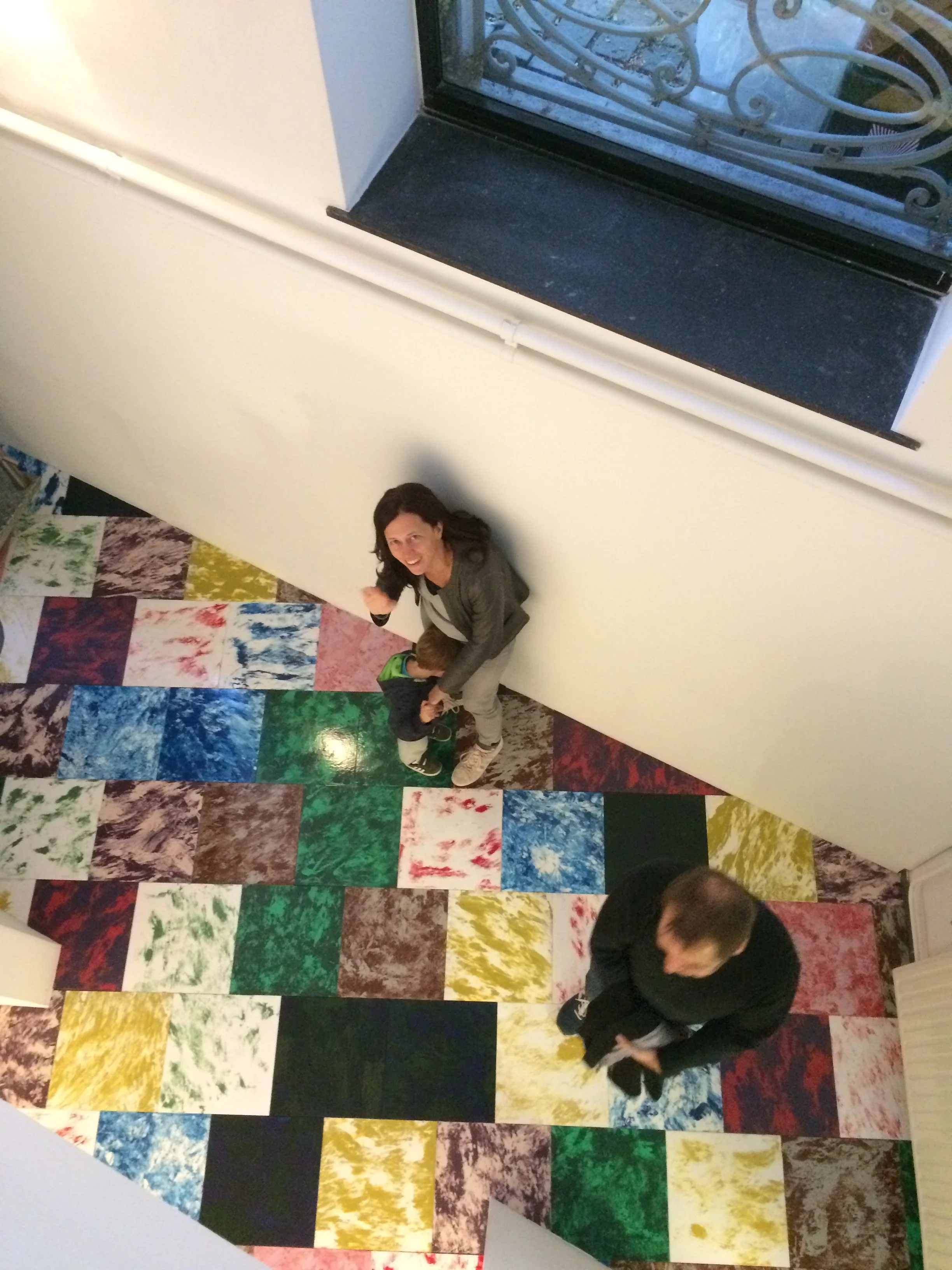
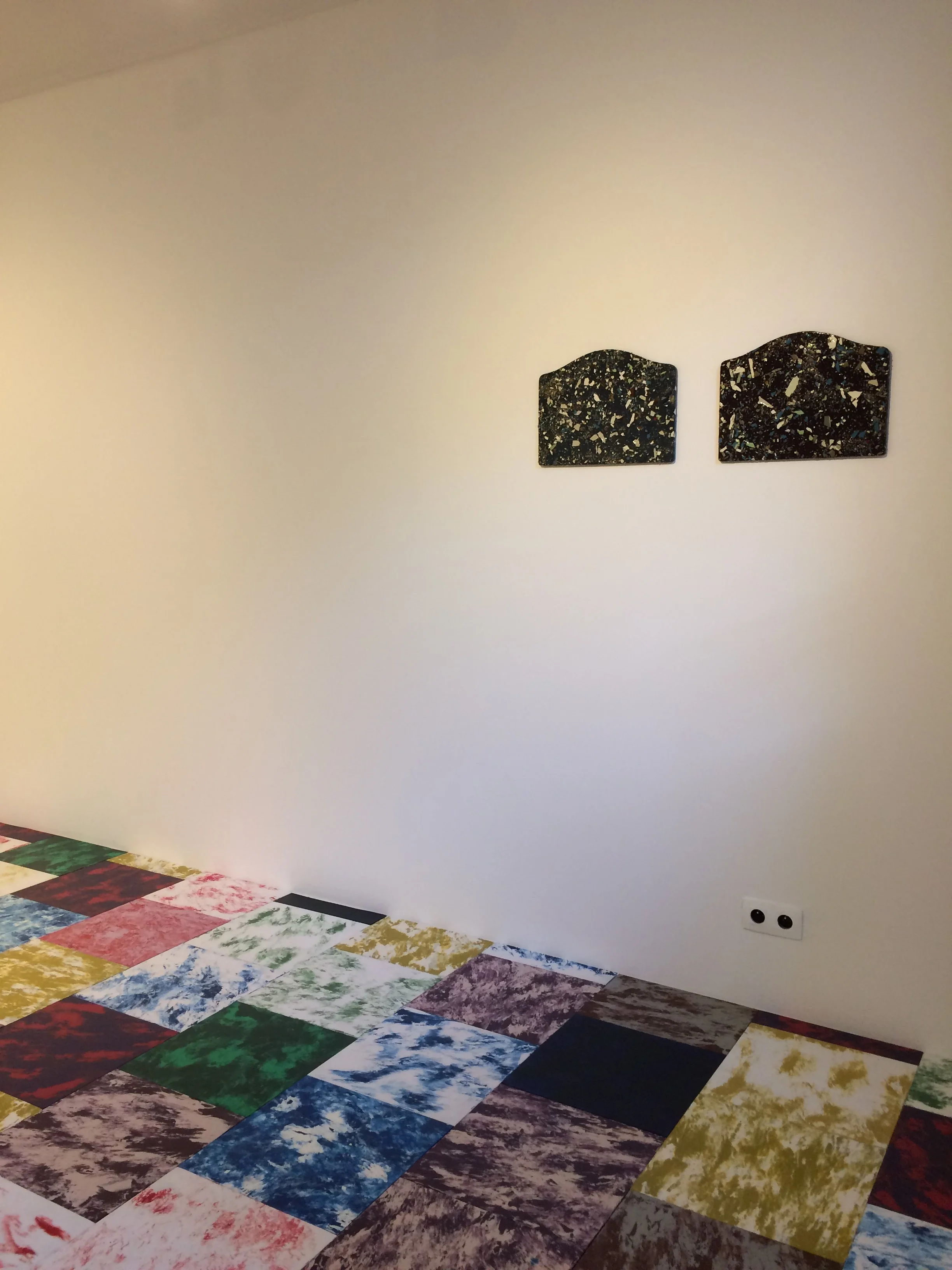
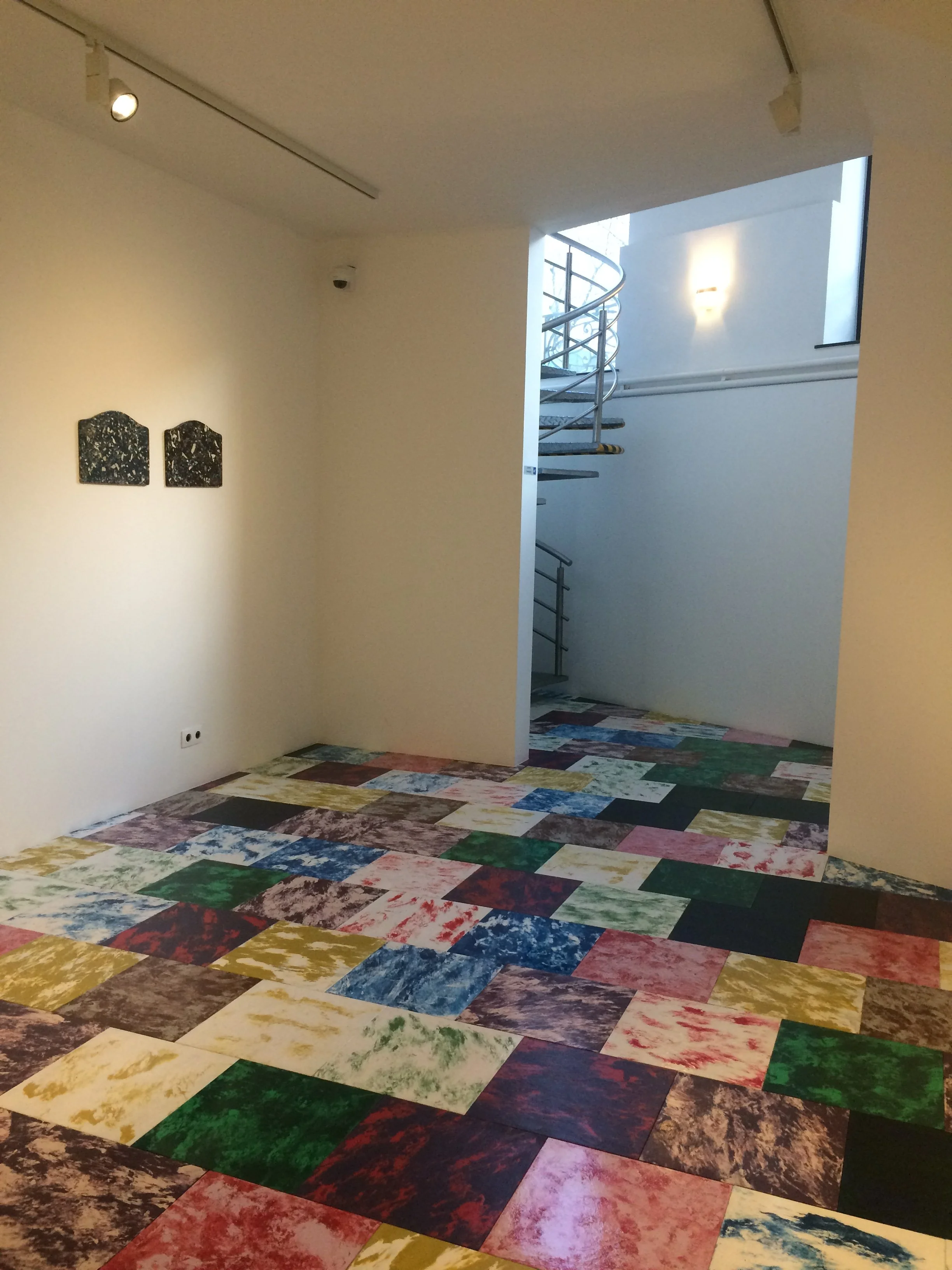
The balcony rail leading to the stairs allows for a plunging view onto the space below. It is here that one is struck first of all by the gaudy character of the brightly coloured paved floor. But on the way down, the eye of the visitor moves to the walls and to what seems to be the only two pieces hanging in the exhibition: to use Liddle’s terminology, the two “fleck paintings”, that is, compositions which have the appearance of abstract paintings but which are only Tachist in appearance and whose creative process, as revealed by the artist, demonstrates the regressive illusionism and the feigned creative nonchalance that Liddle uses so well.
In fact, they are two found shelves upon which Liddle has patiently applied layers of paint, themselves removed by scraping down other painted wood elements found by the artist. In this sense, the casual transfer of material is employed in these works, as a process of pictorial creation.
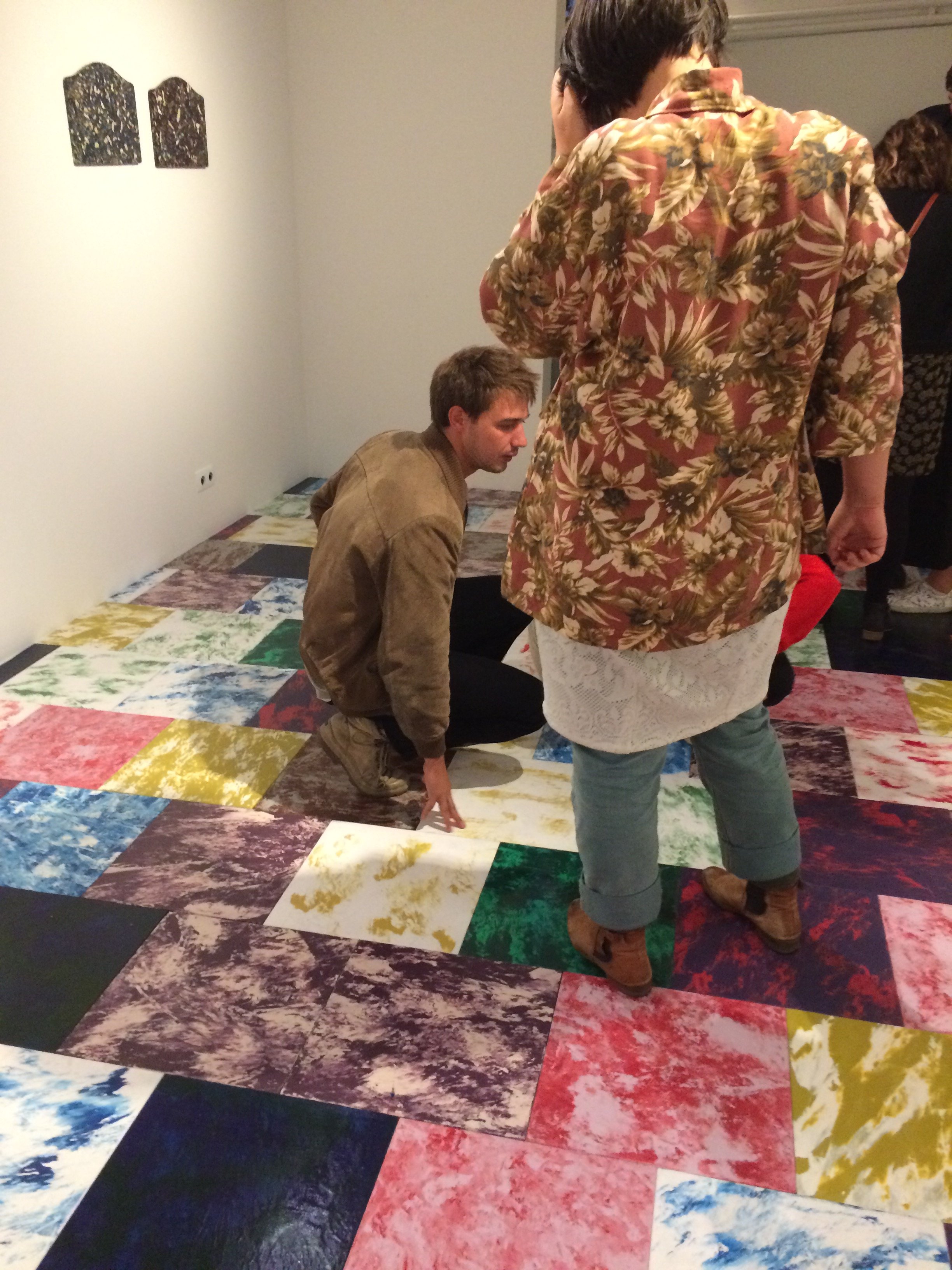
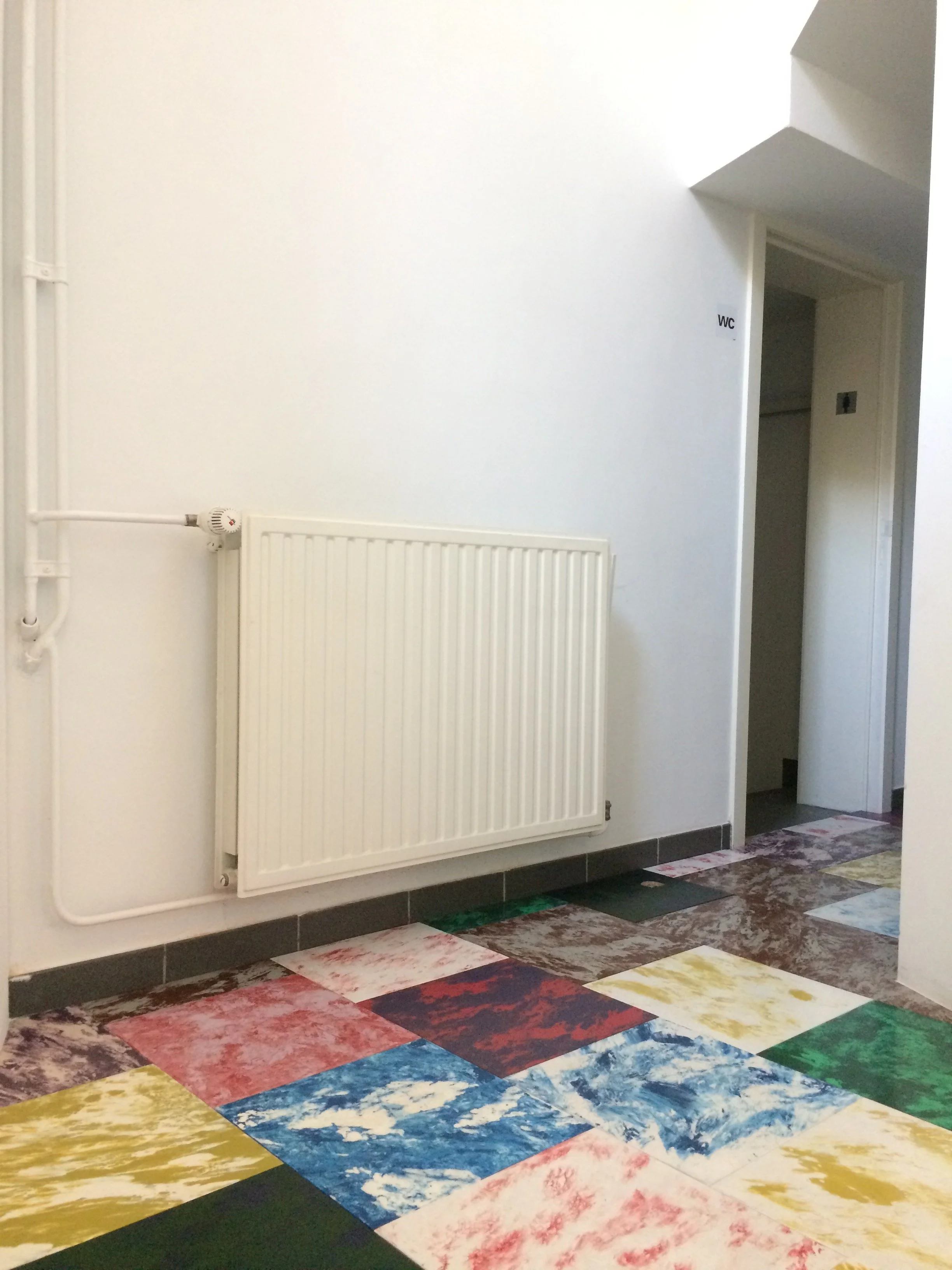
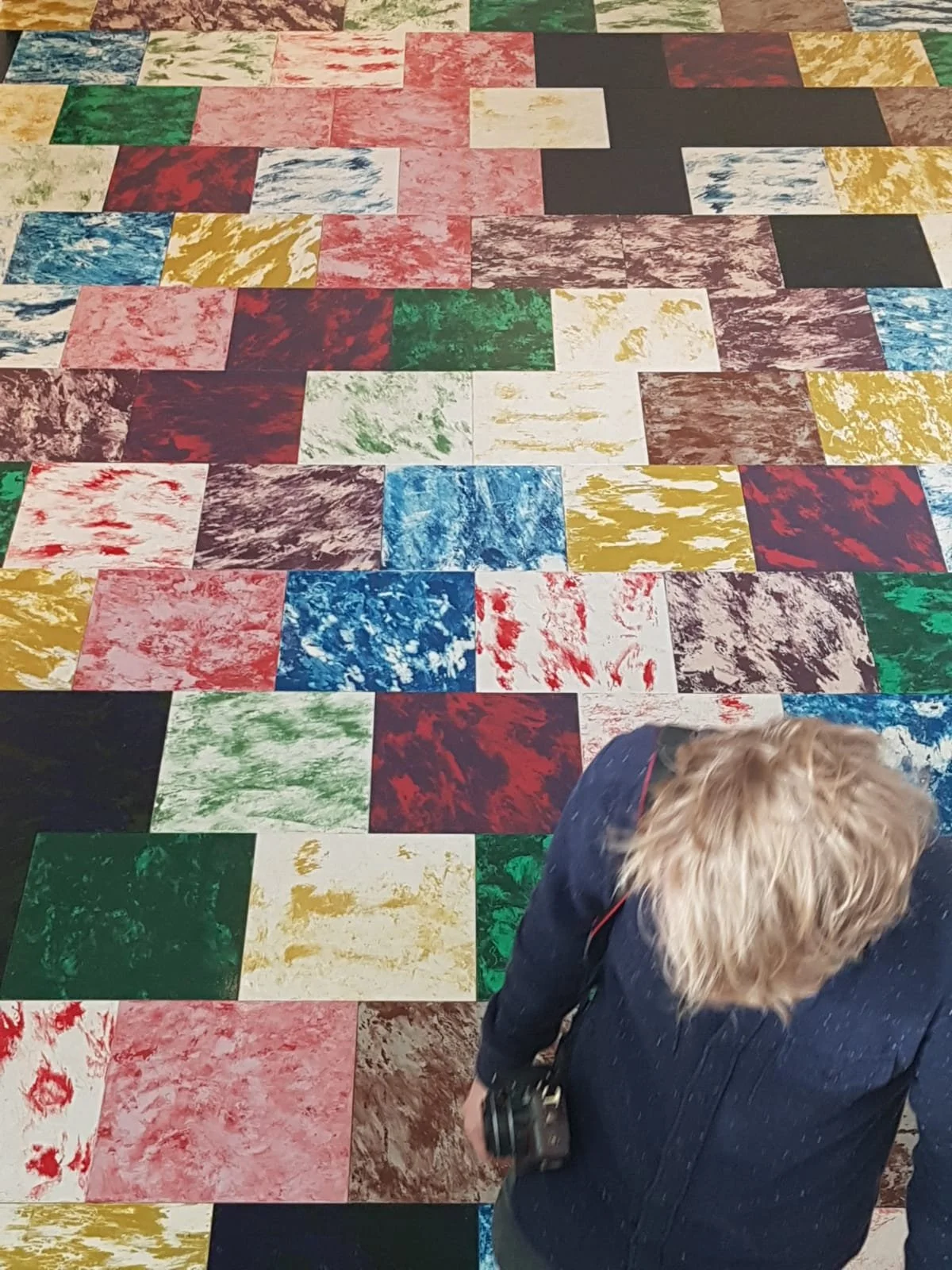
Following the fleck paintings, the distracted attention of the visitor naturally returns to the abundant source of colour which is the floor. At first glance, it seems to be a patchwork of diamond shaped marbled linoleum tiles, resembling those typically found in modest forties and fifties houses in Brussels. Twelve different combinations of colour lend the ensemble a chromatic presence, a little garish and dissonant.
A more attentive examination reveals the trick. As these pseudo-squares of vulgar linoleum are in reality counterfeits, carefully painted, small MDF panels decorated with just enough clumsiness to reveal their deception.
In some way, this extreme trompe l’oeil – not dissimilar to the paintings of Cornelis Gijsbrecht – plays, in the same way as the trompe l’oeil frames of the Dutch artist, with the poverty of the counterfeit object, but, moreover, in bearing the functionality, the mundane use of the reproduced object: it is that which the visitor tramples on, when entering the space, without knowing any better, the main and eponymous painted artwork of the exhibition.
The integration amongst an architectural space, the porosity of genres and aesthetics, the de-hierarchization of making paintings, with enough ambiguity to blur the boundaries, are here, all pushed to the extreme.
In a way, Liddle, using undercover methods and the furtiveness of his own unique painterly gesture, revitalises the very idea of trompe l’oeil.
Moreover, this choice of device, expressed as it is to the letter, these forms of lateralisation/marginalisation of painting which, paradoxically foregrounds the pictorial creation, continues to maintain an unavoidable physical distance. Unless, of course, the visitor should decide to go down on all fours to appreciate the pictorial substance and gesture.
The project’s spatial and conceptual dynamic can only be fully appreciated, when, at the end of the visit, whilst going back upstairs to the first floor, we are able to embrace the formal balance and conceptual complementarity of each of Liddle’s pictorial interventions: between verticality and horizontality, architectural integration and sculptural interruption, his gestures never immediately reveal themselves for what they truly are.
At the end of our visit, we also grasp and appreciate – whether it be a reference to the physical forms in the exhibition or to the necessary audacity of pictorial choices made in the 21st century – the humour and ambiguous truth of the exhibition title: Carrement! indeed.
Text: Emmanuel Lambion